By courting the Shahi Imam of Jama Masjid, Sonia Gandhi has pulled the last plug for her son Rahul Gandhi and the Indian National Congress. This will consolidate the support base behind Narendra Modi. It comes at a time when there is not much scope for a national debate ahead of the general elections in India and little chance for the Congress leaders to clarify their position.
It's an irony that those progressive minds who don't fail in tongue-lashing Narendra Modi are in stoic silence after Sonia Gandhi's flirtations with what is being termed as 'minority appeasement' and 'pseudo-secularism'. My understanding is that this double-standard of the so called secular forces is one of the reasons behind the rise of 'aggressive Hindutwa' in India.
A critical look at the track record of the Congress, will demonstrate that the way Sonia Gandhi has conducted herself is no different from what Indira Gandhi and Rajiv Gandhi did. While Mrs Gandhi was known for courting the Shahi Imam ahead of every polls (she was also known to have courted the RSS during the Emergency and in 1977), Rajiv had the dubious distinction of surrendering to 'institutional Islam' in the Shah Banu Case.
In fact, this emanates from Nehru's understanding of secularism, which is characterised by Western thinking. Nehru can be critiqued for his linear thinking and symbolism on secularism, development and many other socio-political strands. One could argue that Nehru was influenced by some sort of a moral compulsion to protect the minority but in the process overlooked the sentiments and ethos of the majority. India being a much more complex and diverse society the principle of secularism which worked in the West probably resulted in widespread resentment among a large section of Nehru's countrymen.
The whole saga reminds me of a situation that I came across just after my arrival in London in 1999. The BJP-led National Democratic Alliance was in power then during its 13-month stint in government and Mamata Banerjee-led Trinamool Congress was very much part of the coalition. During a private conversation in Bush House, a former BBC colleague from Bangladesh, who is a very well-respected writer, asked me how come Ms Banerjee and the Trinamool Congress allied with the BJP.
I tried to explain that to fight the 'mighty' Marxists in Bengal Ms Banerjee needed both physical, financial and moral support from a bigger player in national politics and since the Congress, Ms Banerjee's parent party, was allegedly hand in glove with the CPI-M, she had very little option but to ally with the BJP.
Obviously, my former colleague was not convinced and tried to impress upon me that after all the 'BJP was communal' and it was 'unethical' on the part of Ms Banerjee to share a coalition and the ministry with them. I tried to underline the fact that real politic in India was much more complex than the conventional divide between 'secularism' and 'communalism' and a much closer look at the regional balance of power, caste equations need to be looked into before jumping into any inference. I also argued that although apparently with secular credentials, the Congress was also blamed for playing the religious card for short-term political gains. Even the self-styled epitome of secular politics in India, the Left, especially the CPI-M, who overlooked the caste and religious realities in favour of a class-based analysis of the Indian society, were not free from such allegations.
With due respect to his secular credentials and the depth of knowledge, I could see that my former colleague was clearly out of touch with the changed ground reality in India. And this is not unusual for someone who is from Bangladesh and has spent a good part of his life in London. But even the conventional wisdom of scholars and journalists in India suffers from such myopic thinking and inconsistencies in their assessment of secularism and plurality.
If Narendra Modi and the BJP is to be blamed for their divisive politics, the same applies to the Congress. The Congress leadership, especially under Indira Gandhi and Rajiv Gandhi, resorted to the divide and rule tactics not only to rule the country but also to manage their own party, especially the regional satraps. Recall how chief ministers were para-trooped from Delhi in the middle of nights only to be elected by the legislative parties without caring for inner-party democracy. And let's not forget if Nehru is credited with practicing democratic pluralism in India, it was threatened by none other than his daughter Mrs Gandhi and grandson Sanjay Gandhi during Emergency.
Obviously, Nehru can't be blamed for the deeds of his daughter and grandson(s) but he was very proud of his Western upbringing and thinking based on European modernity. This personal pride often derided the traditional thinking that prevailed in India. And it was not only Nehru but majority of Indian elites suffered from such derision, be it academics, social and political thinkers, journalists or politicians. For most of them enlightening ordinary Indians was an act of charity that hardly differed from the way the Europeans looked at the natives in colonies.
The transformation of Indian society, especially in the Hindi heartland, can hardly be gauged by sitting in the metropolises or in Lutyens' Delhi. A trip to any semi-urban or rural area would show how the thinking and actions of the masses have been influenced by 'political Hindutwa', and this is irrespective of the fact whether the BJP was the dominant political force there during that period of time. Identifying the Hindu way of life as practiced by a large section of the Indian population with the BJP or the RSS would be an oversimplification of the collective thinking that is prevalent in India. Acknowledging the transformation of the Indian mindset would augur well for the minorities. After all it has been proved time and again that the state has limited power to protect the minorities and their safety can possibly be ensured not by conflict but by respecting and reconciling with the mindset of the majority, thereby entrusting upon them the responsibility of upholding pluralism and tolerance.
Tirthankar Bandyopadhyay is a journalist and media consultant.
He can be contacted at tirthankarb@hotmail.com
All comments are personal.
Saturday

Monday
Cricket, corruption & configuration of power relations
Politics
they say is an art of the possible. It's also a great leveller. If not how come
those who bay for each other’s blood day in and day out are in stoic silence
when it comes to the Board of Control for Cricket in India or its more popular
acronym, the BCCI. It seems that political rivals like the Jaitleys, the
Shuklas, the Pawars and many others are in collusive silence.
Politics
they say make strange bedfellows. Cricket also does the same, at least in
India. Or is it the politics of cricket that turns political adversaries into
closest of friends!
James Astill, former South Asia Correspondent of The Economist, has written
extensively on Indian cricket. In his book - ‘The Great Tamasha: Cricket, Corruption and the Turbulent Rise of Modern India’ -
James argues that the game of great uncertainty as manifested in all its forms
in the country is a mirror image of modern India.
Cricket represents rising aspiration, innovation, increased
competition, greater opportunities, determination coupled with killer instinct, glitz, glamour, fame, wealth but at the same time reflects consumerism, stark inequality, money and muscle power, sleaze, big
ticket corruption and what not. No wonder, many describe cricket as India’s national sports
which was incidentally invented by the English.
Sleaze and corruption come with wealth, power and influence
and the BCCI is no exception. In fact, India's richest sporting body and arguably the world's wealthiest cricket board has outgrown itself to the extent of being considered a 'cricket bully' among the nations playing the sports. This is, however, a reaction to the unquestionable power and influence that the English and the Aussies enjoyed over many decades.
In India, the BCCI is enormously influential and it is any politician or businessman's dream to head the coveted organisation. Accumulation of power and wealth have resulted in
corruption, defined as dishonest
or fraudulent conduct by those in power. N Srinivasan is not the only top BCCI official who is facing corruption charges, but probably no one else has given the organisation such a bad name and created such public outrage that the country's top court had to intervene.
The Supreme Court literally booted out Srinivasan from BCCI's top job and asked batting maestro Sunil Gavaskar to lead the show during the time of the lucrative and popular Indian Premier League (IPL), which incidentally has been the bone of contention between disparate groups involving cricket.
The top court has asked for cleaning up cricket amidst apprehension as to whether it is at all possible. Some are enthused by the elevation of Gavaskar as BCCI's interim head, the first Indian cricketer to do so. The moot question though is whether Gavaskar is qualified to do so or whether the political dynamics of Indian cricket provides him with any opportunity to carry out the task.
Firstly, the legendary Indian batsman, with bundle of contracts with the BCCI is a direct beneficiary of the Srinivasan-regime. If patron-client relationship characterises Srinivasan-Gavaskar equation, there is no reason to believe that the former Indian captain will rock his own boat or that of his sympathiser.
Those who know Gavaskar well, will appreciate that he is one of the smartest chaps in the cricketing world for many years. Rather than positioning himself for the posts of manager or coach, or selector or any official involved with the Indian cricket team, he chose a different trajectory to avoid 'increased scrutiny'. To avoid public glare he didn't even throw his weight behind son Rohan to get the young Gavaskar in the Indian squad.
Those who saw Gavaskar on television after the Supreme Court floated its suggestion, would probably acknowledge that he was palpably unsettled only trying to camouflage it by talking about the 'incredible honour' that was bestowed upon him. If body language and worldly arguments are any indication, Gavaskar will only try to buy his time rather than taking any initiative to ensure structural changes in the BCCI.
At a more broader level of analysis, Gavaskar's elevation is a manifestation of 'depoliticisation', probably in an effort to veil the 'murky politics of cricket' in India. As an outsider in BCCI, Gavaskar is not directly involved as an operator in its organisational politics. As a successful player he can be clubbed under the bracket of technocrats, who are better suited for advisory roles rather than operating at the political level.
Indian cricket is essentially facing a political crisis and it calls for a political solution. After all, it's about authority which is defined by power relations. Political solutions can only be achieved by re-configuring power relations, as happens during elections, and not by overlooking the political dynamics. By nominating Gavaskar as an interim head of the BCCI, the Supreme Court tried to thrust upon (or suggest) essentially a non-political solution (if any) to a political problem.
The initiative to depoliticise probably reflects the increased apathy about political elements (mostly politicians), which undoubtedly is a cause of concern in India. But a possible way out of the crisis can only happen not by negating politics but by re-configuring the political variables. The government, the judiciary, present and former cricketers and those associated with the physical form of the game and above all millions of cricket buffs have a significant role and high stakes in such reconfiguration.
All comments are personal.
At a more broader level of analysis, Gavaskar's elevation is a manifestation of 'depoliticisation', probably in an effort to veil the 'murky politics of cricket' in India. As an outsider in BCCI, Gavaskar is not directly involved as an operator in its organisational politics. As a successful player he can be clubbed under the bracket of technocrats, who are better suited for advisory roles rather than operating at the political level.
Indian cricket is essentially facing a political crisis and it calls for a political solution. After all, it's about authority which is defined by power relations. Political solutions can only be achieved by re-configuring power relations, as happens during elections, and not by overlooking the political dynamics. By nominating Gavaskar as an interim head of the BCCI, the Supreme Court tried to thrust upon (or suggest) essentially a non-political solution (if any) to a political problem.
The initiative to depoliticise probably reflects the increased apathy about political elements (mostly politicians), which undoubtedly is a cause of concern in India. But a possible way out of the crisis can only happen not by negating politics but by re-configuring the political variables. The government, the judiciary, present and former cricketers and those associated with the physical form of the game and above all millions of cricket buffs have a significant role and high stakes in such reconfiguration.
Saturday
Why Tony Benn is my hero in British politics
The past week marks a sad one for millions of hardworking people across Britain and around the globe, who stood up against the onslaught of Neoliberal economic policies.
Tony Benn, hated by many during his parliamentary years and endeared by a large cross-section from the political spectrum when he "concentrated on politics" after retiring from the front-line, passed away at the age of 88.
The past week also witnessed the unexpected death of Bob Crow, the Rail and Maritime Transport (RMT) union leader - a darling to his members and a political foe to those on the other side of the negotiating table, be it Labour, Tory or the Lib-Dems.
Both were old-school in their thoughts and actions, but they used the strength of their life force literally shouting in favour of the ordinary, often forcing the powerful to part with some of their privileges, be it financial or otherwise.
Tony and Bob also had their share of differences. Bob was never afraid of defending his salary, which was reported to be £145,000 but he suggested it was closer to £90,000. Bob thought he was worth it because RMT's members had received pay rises every year even during austerity, good pensions and good holiday allowances. Tony on the other hand shunned his hereditary peerage to uphold the supremacy of parliament and its electors.
Westminster was never tired of making fun of their political caricature, and yet their success lies in the broad consensus across the political community that Tony and Bob stood for what they believed in.
I am not sure if history would have assessed Bob differently had he lived a long enough life like Tony. He departed his worldly stage as a fighter and as someone who was probably born to rebel. Tony was much more astute in his political thoughts and imagination. He might have been branded a maverick and 'dangerous' during his parliamentary days, and yet many of Tony's thoughts on gay marriage, nuclear disarmament and Ireland became mainstream in the contemporary and are close to popular imagination.
Strike calls given by Bob's union - the RMT- might have caused a lot of discomfort for me personally and many others over the past few years, and yet it gave me immense pleasure when he held the pinstriped bosses by the horn. No wonder the willy movers in City Hall hated Bob, but they knew the beast in him couldn't be overlooked. He was more of a Socialist bully at a time when the interests of the working class were overlooked on the pretext of business motives.
Tony Benn, on the other hand, was a cerebral politician, uncompromising in his belief even at the cost of being isolated. He might not have been a smooth operator in real politics during his parliamentary years but later on people from all political hues saw in him a grandfatherly figure who probably set the benchmark of conviction politics at a time when compromises happened by the fall of a hat.
In his family life, Tony was a loving grandfather. He once told me that Indian grandparents are luckier as they can see their grandchildren grow up as against in the West where the elderly are visited occasionally.
I didn't know then but now I know another reason behind Tony's liking for India. His father William Wedgwood Benn was appointed Secretary of State for India by Ramsay MacDonald in 1929, a position he held until 1931.
I will cherish my brief interaction with Tony Benn, probably one of the greatest conviction politicians I have ever come across, his firebrand speeches and radical thinking.
All comments are personal.
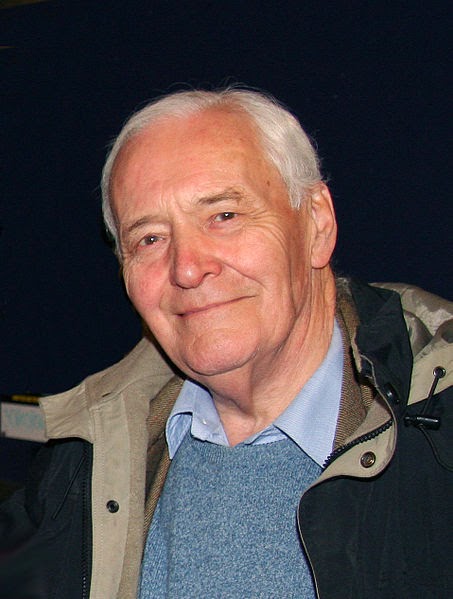 |
| Tony Benn was a radical politician and a loving grandfather |
Tony Benn, hated by many during his parliamentary years and endeared by a large cross-section from the political spectrum when he "concentrated on politics" after retiring from the front-line, passed away at the age of 88.
The past week also witnessed the unexpected death of Bob Crow, the Rail and Maritime Transport (RMT) union leader - a darling to his members and a political foe to those on the other side of the negotiating table, be it Labour, Tory or the Lib-Dems.
Both were old-school in their thoughts and actions, but they used the strength of their life force literally shouting in favour of the ordinary, often forcing the powerful to part with some of their privileges, be it financial or otherwise.
Tony and Bob also had their share of differences. Bob was never afraid of defending his salary, which was reported to be £145,000 but he suggested it was closer to £90,000. Bob thought he was worth it because RMT's members had received pay rises every year even during austerity, good pensions and good holiday allowances. Tony on the other hand shunned his hereditary peerage to uphold the supremacy of parliament and its electors.
Westminster was never tired of making fun of their political caricature, and yet their success lies in the broad consensus across the political community that Tony and Bob stood for what they believed in.
I am not sure if history would have assessed Bob differently had he lived a long enough life like Tony. He departed his worldly stage as a fighter and as someone who was probably born to rebel. Tony was much more astute in his political thoughts and imagination. He might have been branded a maverick and 'dangerous' during his parliamentary days, and yet many of Tony's thoughts on gay marriage, nuclear disarmament and Ireland became mainstream in the contemporary and are close to popular imagination.
 |
| Bob Crow was an old-school trade unionist who scared many pinstriped modern-day bosses |
Strike calls given by Bob's union - the RMT- might have caused a lot of discomfort for me personally and many others over the past few years, and yet it gave me immense pleasure when he held the pinstriped bosses by the horn. No wonder the willy movers in City Hall hated Bob, but they knew the beast in him couldn't be overlooked. He was more of a Socialist bully at a time when the interests of the working class were overlooked on the pretext of business motives.
Tony Benn, on the other hand, was a cerebral politician, uncompromising in his belief even at the cost of being isolated. He might not have been a smooth operator in real politics during his parliamentary years but later on people from all political hues saw in him a grandfatherly figure who probably set the benchmark of conviction politics at a time when compromises happened by the fall of a hat.
In his family life, Tony was a loving grandfather. He once told me that Indian grandparents are luckier as they can see their grandchildren grow up as against in the West where the elderly are visited occasionally.
I didn't know then but now I know another reason behind Tony's liking for India. His father William Wedgwood Benn was appointed Secretary of State for India by Ramsay MacDonald in 1929, a position he held until 1931.
I will cherish my brief interaction with Tony Benn, probably one of the greatest conviction politicians I have ever come across, his firebrand speeches and radical thinking.
All comments are personal.
When pride of being an Indian takes a beating
Often
distance gives a different perspective. After what happened in the Indian Parliament on Thursday, I deliberately kept myself away from other colleagues at the place where I work. Some of them have links with India and others are
fascinated by the tremendous strides made by the country which was once ruled
by the British.
I was apprehensive
that someone would ask me uncomfortable questions about what happened in the
Indian Parliament. I didn’t want to be caught on the wrong foot on my country,
which incidentally is the largest democracy in the world.
On second
thought, it seemed that I was actually shying away from myself. The sheer shame
of facing the reality about the transformation of Indian polity. Often our
leaders and those of us who live away from home use words like pluralism,
diversity, empowerment – in one way or
the other they all are related to democracy. We take pride in the fact that
despite her deficits, India is a vibrant democracy. When Europeans, who are so
used to homogeneity, raise eyebrows on the chaos in India, we tell them India
is too complex a structure to be compared to Europe. At the end of a long discussion
on how diverse, multi-dimensional and colourful India is, we add a footnote
stating that despite all our problems India is united, proud and values its
pluralism, diversity and democracy.
I wonder
what some of my European friends having interests in India would say after what
happened in the Indian Parliament on Thursday. Frankly speaking, I started
feeling restless the very moment, an Indian television channel which beams here
in the UK informed me about the use of pepper spray and knives in the temple of
democracy, a term often used by Indians. To relieve me from the restlessness, I
posted on the social media: “Indian lawmakers act as insurgents in the land of Mahatma.”
It was an
instant reaction, but on reflection, I was swamped in depression. The
significant strides that India has made in the fields of science and
technology, software development, human resources, academia and services etc.
are rated even more highly as we have been able to achieve them despite
being a democracy where divergence of views and opinion are taken into
consideration. Despite the high growth rate of China, India is preferentially
treated because she is a democracy as compared to China being under a one-party
rule. We know where our strength lies and yet none other than the lawmakers
decided to tarnish India’s image. Our pride in democracy, pluralism and
tolerance has all fallen flat with one stroke of an action.
Twenty years
back as a young journalist, I had a chance to meet Hiren Mukherjee, the
celebrated parliamentarian of CPI. As expected, I was mesmerised by his
depth of knowledge and yet his patience to listen to somebody as inexperienced
and naïve as myself. Despite his unflinching faith in Communism, the late
parliamentarian told me that India’s strength lies in its multi-party
democracy. “Our strength lies in the power of our patience and our readiness to
absorb,” I remember him telling me.
Then he
narrated instances from his parliamentary life when Nehru would often make it a
point to listen to his speeches as well as those of other political adversaries
like Shyama Prasad Mukherjee. “We were
political adversaries but our friendship and respect for each other were still
intact,” he told me. On hindsight, it seems that is the novelty of democracy
and is now gradually disappearing from Indian polity.
Any sane
person would support social mobility, especially in a country as complex as
India and empowerment of people coming from different socio, cultural, ethnic
and regional groups augurs well for democracy. Unfortunately, that has also
contributed to the intolerance and impatience, and often the animosity between
different social elements was reflected on the floor of the house. Even live
telecast of the parliamentary proceedings couldn’t stop the lawmakers from
behaving inappropriately. They often take pride in the fact that such unruly behaviour
made them more popular among their constituents and ensured electoral gains.
Does it
imply that India as a nation is becoming impatient, intolerant and
argumentatively perilous. Nothing can be more unfortunate in a country which takes
pride in being the successor of great leaders like Nehru, Gandhi, Tagore,
Netaji, Abul Kalam Azad and many more. None can deny the political differences
between Tagore, Netaji, Nehru and the Mahatma, frankly they were quite
stark, and yet not for once did they fail in publicly acknowledging respect
towards their political opponents.
Tirthankar Bandyopadhyay is a journalist and media consultant.
He can be contacted at tirthankarb@hotmail.com All comments are personal.
Thursday
Theorising Kejriwal's Muffler
Arvind Kejriwal is always seen sporting a muffler. Even when he was formally taking over as the chief minister of Delhi, his trademark muffler was seen hanging on the coveted chair. I wonder if this depicts a sense of strong determination and will power, without caring about what others may think or make out of it.
Generally, politicians are used to pulling out their best assets in the wardrobe while taking over positions of pride and power. For Kejriwal, however, taking over as the Delhi chief minister apparently made no difference, and he was sporting the same attire as he did on any other day.
One might argue that it was a well choreographed move to demonstrate that he was still an 'aam aadmi' or the proverbial ordinary man. A subtle analysis, based on a different context and a separate set of parameters, may lead to a different conclusion.
People generally tend to avoid using mufflers or monkey caps (also known as balaclava) on the presumption that they tend to infuse a sense of image to the user which is construed as not so smart (or unsmart in common parlance). Since most of us are interested in showing and seeing ourselves in good and smart light, we tend avoid attires which don't do so.
There is a general feeling that those who use muffler or monkey caps are either elderly or more concerned about their health or are risk-averse or are not (so much) bothered about worldly style. The flamboyance that is synonymous to charisma and is very important in politics in a country like India, doesn't go very well with mufflers, especially if it is worn in the style that Kejriwal does. But he is neither elderly, nor risk averse or too concerned about his health. In fact, very few people are as risk-prone and less concerned about himself as Kejriwal.
So the obvious conclusion is that Kejriwal is strong on determination and is least bothered about what others may think or make out of him. Probably, this flows from his Haryanvi genealogy. Kejriwal is from Siwani in Haryana. I am not sure whether he is a Jat, but Jats are credited with dogged determination, with a clear sense of purpose. This might be the reason behind him getting into the IIT, one of the premier institutes in India or the Indian Revenue Service. No wonder, Kejriwal left a coveted job to venture out in a life of uncertainty and risk
Tirthankar Bandyopadhyay is a journalist and media consultant.
He can be contacted at tirthankarb@hotmail.com
All comments are personal.
 |
| Courtesy: Hindustan Times |
Generally, politicians are used to pulling out their best assets in the wardrobe while taking over positions of pride and power. For Kejriwal, however, taking over as the Delhi chief minister apparently made no difference, and he was sporting the same attire as he did on any other day.
One might argue that it was a well choreographed move to demonstrate that he was still an 'aam aadmi' or the proverbial ordinary man. A subtle analysis, based on a different context and a separate set of parameters, may lead to a different conclusion.
People generally tend to avoid using mufflers or monkey caps (also known as balaclava) on the presumption that they tend to infuse a sense of image to the user which is construed as not so smart (or unsmart in common parlance). Since most of us are interested in showing and seeing ourselves in good and smart light, we tend avoid attires which don't do so.
There is a general feeling that those who use muffler or monkey caps are either elderly or more concerned about their health or are risk-averse or are not (so much) bothered about worldly style. The flamboyance that is synonymous to charisma and is very important in politics in a country like India, doesn't go very well with mufflers, especially if it is worn in the style that Kejriwal does. But he is neither elderly, nor risk averse or too concerned about his health. In fact, very few people are as risk-prone and less concerned about himself as Kejriwal.
So the obvious conclusion is that Kejriwal is strong on determination and is least bothered about what others may think or make out of him. Probably, this flows from his Haryanvi genealogy. Kejriwal is from Siwani in Haryana. I am not sure whether he is a Jat, but Jats are credited with dogged determination, with a clear sense of purpose. This might be the reason behind him getting into the IIT, one of the premier institutes in India or the Indian Revenue Service. No wonder, Kejriwal left a coveted job to venture out in a life of uncertainty and risk
Tirthankar Bandyopadhyay is a journalist and media consultant.
He can be contacted at tirthankarb@hotmail.com
All comments are personal.
Subscribe to:
Posts (Atom)